|
Network Cables
Cat 5e Patch Cables
Cat 5e Crossover Patch Cables
Cat 6 Patch Cables
Cat 6 Crossover Patch Cables
Cat 5e Patch Panels
Cat 6 Patch Panels
Cat 5e Keystone Jacks
Cat 3 Keystone Jacks
Cat 6 Keystone Jacks
Bulk Cable Spools
Decora Wall Plates
Wall Plates
KVM Switches
Modular Plugs
Network Cards
Network Switches
RJ45 Modular Adapters
RJ45 Couplers
Routers
Surface Mount Boxes
Belden Products
Belden 1213 Cat 5e Bulk Cable
Belden 2413 Cat 6 Bulk Cable
Belden MDVO Cat 6 Jacks
Belden Cat 6+ Modular Jack, KeyConnect Style
Fiber Optic Products
Fiber Optic Patch Cords
Fiber Optic Patch Panels
Fiber Optic Adapters
Fiber Optic Couplers
Media Converters
Cable Management
Cable Ties
Horizontal Cable Managers
Racks
Shelves
Wall Mount Patch Panel Brackets
Vertical Cable Manager
Telephone Cables
Amphenol (Telco) Cables
Bix Products
Bulk Cable
Cat 3 Keystone Jacks
Decora Jacks
Line Cords
Surface Jacks
Wall Jacks
Computer Cables
Firewire Cables
IEEE Printer Cables
KVM Cables
Modem Cables
Parallel Printer Cables
PS2 Mouse & Keyboard Cables
Premium SVGA Monitor Cables
SCSI Cables
USB Cables
VGA Monitor Cables
Coax Products
Bulk Cable
Crimp-On Connector
F Connector + 4 Contact Jack Wall Plate
Keystone F Connector Insert
Audio Video Cables
Component Video Cables
Composite Video Cables
Digital Coax Cables
DVI Cables
HDMI Cables
Keystone Inserts
Premium SVGA Monitor Cables
RGB Cables
S-Video Cables
Speaker Wire
Subwoofer Cable
Tools and Testers
Cable Tester
Coax Cable Stripper
Coax Crimp Tool
110 Punch Down Tool
BIX Punch Down Tool
Rj45 Crimp Tool
RJ45 and RJ11 Crimp Tool
Telephones and Telephone Equipment
|
|
Network Cables | Cat 5e (category 5e) Patch Cables
Cat 5e Patch Cables
Cat 5e 350Mhz patch cables easily handle bandwidth intensive applications and more. |
|
|
| |
|
|
| Product Features: |
 |
 |
|
Access Technologies UL/CSA certified Cat 5e patch cables meet all the TIA/EIA standards. Our enhanced Cat 5e patch cables are well constructed using Enhanced Cat 5e bulk cable, which consists of 4 unshielded twisted pairs, 24 AWG. stranded conductors, and a PVC jacket. We terminate the snag less molded booted Enhanced Cat 5e cables with short body RJ45 plugs, which are plated with 50 microns of gold plating per contact. Our molded, snagless boot prevents unwanted cable snags during installation/maintenance and provides extra strain-relief.
 |
Conductor: 4-pair 24 AWG Stranded Copper |
|
Connector: 50-micron gold plated RJ-45 Male to Male |
|
Molded, Snagless boot prevents unwanted cable snags |
|
Jacket: PVC |
|
Designed For: Network Interface Cards, Hubs, Switches, Routers, DSL/Cable Modems, Patch Panels and all other twisted-pair applications |
|
Wired: 568A Standard |
|
Meets or Exceeds Category 5e (Cat 5e) specifications |
|
Certifications: TIA/EIA; UL Listed |
|
|
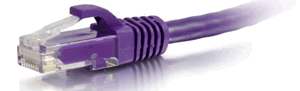
|
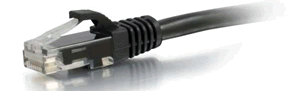
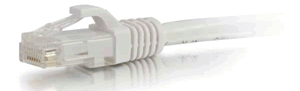
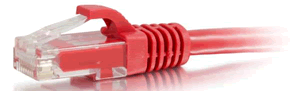
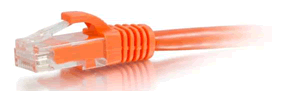
| Cat 5e Patch Cables are available in the following colours: |
|
|
|
|
|
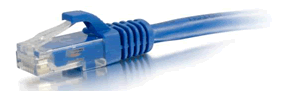
Blue Cat 5e Network Cable |
|
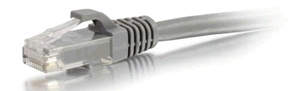
Grey Cat 5e Network Cable |
|
White Cat 5e Network Cable |
|
Red Cat 5e Network Cable |
|
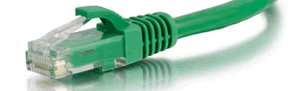
Green Cat 5e Network Cable |
|
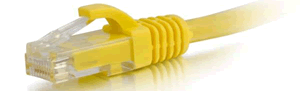
Yellow Cat 5e Network Cable |
|
Black Cat 5e Network Cable |
|
Orange Cat 5e Network Cable |
|
Purple Cat 5e Network Cable |
|
|
|
| Cat 5e Patch Cables are available in the following lengths: |
|
|
|
|
|
1 Foot Cat 5e Patch Cable |
|
15 Foot Cat 5e Patch Cable |
|
2 Foot Cat 5e Patch Cable |
|
20 Foot Cat 5e Patch Cable |
|
3 Foot Cat 5e Patch Cable |
|
25 Foot Cat 5e Patch Cable |
|
4 Foot Cat 5e Patch Cable |
|
30 Foot Cat 5e Patch Cable |
|
5 Foot Cat 5e Patch Cable |
|
35 Foot Cat 5e Patch Cable |
|
6 Foot Cat 5e Patch Cable |
|
50 Foot Cat 5e Patch Cable |
|
7 Foot Cat 5e Patch Cable |
|
75 Foot Cat 5e Patch Cable |
|
10 Foot Cat 5e Patch Cable |
|
100 Foot Cat 5e Patch Cable |
|
14 Foot Cat 5e Patch Cable |
|
|
|
|
|
|
| Information about Cat 5 and Cat 5e Patch Cables: |
|
|
|
The need for more bandwidth and faster networks forced a new standard in Category cabling in the late 90's. The Category 5 standard was ratified and the new cable standard became 100MHz at 100Mbps. Cat 5 was short lived once Category 5 Enhanced (or Cat 5e) came along. Cat 5e patch cables are tested up to 350MHz at 1 Gbps.
Category 5 cable, commonly known as Cat 5, is an unshielded twisted pair type cable designed for high signal integrity. The actual standard defines specific electrical properties of the wire, but it is most commonly known as being rated for its Ethernet capability of 100 Mbit/s. Its specific standard designation is EIA/TIA-568. Cat 5 cable typically has three twists per inch of each twisted pair of 24 gauge copper wires within the cable. The twisting of the cable reduces electrical interference and crosstalk. Another important characteristic is that the wires are insulated with a plastic (FEP) that has low dispersion, that is, the dielectric constant of the plastic does not depend greatly on frequency. Special attention also has to be paid to minimizing impedance mismatches at connection points.
Cat 5 cables are often used in structured cabling for computer networks such as Fast Ethernet, although they are also used to carry many other signals such as basic voice services, token ring, and ATM (at up to 155 Mbit/s, over short distances).
Cat 5e cable is an enhanced version of Cat 5 for use with 1000BASE-T (gigabit) networks, or for long-distance 100 Base-T links (350 m, compared with 100 m for Cat 5). It must meet the EIA/TIA 568A-5 specification. Virtually all cables sold as Cat 5 are actually Cat 5e. The markings on the cable itself reveal the exact type.
How to Make a Category 5 / Cat 5e Patch Cable
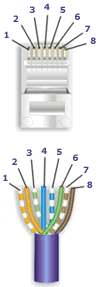 |
568 - B Wiring
|
Pair #
|
Wire
|
Pin #
|
|
1 - White / Blue
|
White / Blue
|
5
|
|
Blue / White
|
4
|
|
2 - White / Orange
|
White / Orange
|
1
|
|
Orange / White
|
2
|
|
3 - White / Green
|
White / Green
|
3
|
|
Green / White
|
6
|
|
4 - White / Brown
|
White / Brown
|
7
|
|
Brown / White
|
8
|
|
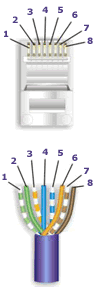 |
568 - A Wiring
|
Pair #
|
Wire
|
Pin #
|
|
1 - White / Blue
|
White / Blue
|
5
|
|
Blue / White
|
4
|
|
2 - White / Green
|
White / Green
|
1
|
|
Green / White
|
2
|
|
3 - White / Orange
|
White / Orange
|
3
|
|
Orange / White
|
6
|
|
4 - White / Brown
|
White / Brown
|
7
|
|
Brown / White
|
8
|
|
Notes for wiring diagrams above:
1. For patch cables, 568-B wiring is by far, the most common method.
2. There is no difference in connectivity between 568B and 568A cables. Either wiring should work fine on any system.
3. For a straight through cable, wire both ends identical.
4. For a crossover cable, wire one end 568A and the other end 568B.
5. Do not confuse pair numbers with pin numbers. A pair number is used for reference only (eg: 10BaseT Ethernet uses pairs 2 & 3). The pin numbers indicate actual physical locations on the plug and jack.
Patch Cable Assembly Instructions
| 1 |
Skin off the cable jacket approximately 1" or slightly more. |
| 2 |
Un-twist each pair, and straighten each wire between the fingers.
|
| 3 |
Place the wires in the order of one of the two diagrams shown above (568B or 568A). Bring all of the wires together, until they touch.
|
| 4 |
At this point, recheck the wiring sequence with the diagram.
|
| 5 |
Optional: Make a mark on the wires at 1/2" from the end of the cable jacket. |
| 6 |
Hold the grouped (and sorted) wires together tightly, between the thumb, and the forefinger. |
| 7 |
Cut all of the wires at a perfect 90 degree angle from the cable at 1/2" from the end of the cable jacket. This is a very critical step. If the wires are not cut straight, they may not all make contact. We suggest using a pair of scissors for this purpose. |
| 8 |
Conductors should be at a straight 90 degree angle, and be 1/2" long, prior to insertion into the connector. |
| 9 |
Insert the wires into the connector (pins facing up). |
| 10 |
Push moderately hard to assure that all of the wires have reached the end of the connector. Be sure that the cable jacket goes into the back of the connector by about 3/16". |
| 11 |
Place the connector into a crimp tool, and squeeze hard so that the handle reaches it's full swing. |
| 12 |
Repeat the process on the other end. For a straight through cable, use the same wiring. For a "crossover" cable, wire one end 568A, and the other end 568B. |
| 13 |
Use a cable tester to test for proper continuity. |
Notes Regarding Making Category 5 Patch Cable
1) The RJ-45 plugs are normally made for either solid conductors or stranded conductors. It is very important to be sure that the plug that you use matches the conductor type. It is extremely difficult to tell the difference between the two by looking at them. When you buy these plugs, be sure to categorize, and store them carefully. Using the wrong type can cause intermittent problems.
2) Ordinarily, it would be taboo to untwist the pairs of any category 5 cable. The one exception to this rule is when crimping on RJ-45 plugs. It would be impossible to insert the wires into the channels without first untwisting and straightening them. Be sure not to extend the un-twisting, past the skin point. If you do it properly, you will wind up with no more than 1/2" of untwisted conductors (up to 1/2" of untwist meets the cat 5 specification).
3) If the completed assembly does not pass continuity, you may have a problem in one, or both ends. First try giving each end another crimp. If that does not work, then carefully examine each end. Are the wires in the proper order? Do all of the wires fully extend to the end of the connector? Are all of the pins pushed down fully. Cut off the suspected bad connector, and re-terminate it. If you still have a problem, then repeat the process, this time giving more scrutiny to the end that was not replaced.
4) It is good to be prepared to make your own patch cables. There may be many instances where you may fall short on supply, and making a cable will surely get you out of a jam. However, there comes a point where the practicality curve will lead you to factory made cables. Making several cables can be very labor intense. Factory made cables typically have better tolerances, and consequently have better quality than field made cables.
|
|


